(Nederlands) Historyland neemt afscheid van oprichter Arie van den Ban
Sorry, this entry is only available in Nederlands and Deutsch.
(Nederlands) Mammoethut
Sorry, this entry is only available in Nederlands and Deutsch.
(Nederlands) Wetenschappelijk onderzoek
Sorry, this entry is only available in Nederlands and Deutsch.
(Nederlands) Mammoethut
Sorry, this entry is only available in Nederlands and Deutsch.
(Nederlands) Nieuw lezingenseizoen 2025-2026 van start bij Historyland
Sorry, this entry is only available in Nederlands.
Enamel Organ: A Fascinating Feature of Mammoth Teeth

Insight into the Unique Dental Development of Mammoths Unlike most mammals, mammoths replace their teeth in a unique way: horizontally, moving from the back of the jaw to the front. A tooth or molar actively used for grinding food is replaced by a larger subsequent tooth. This process occurs up to five times throughout the […]
Woolly Rhinoceros: A Journey into the Ice Age

A Glimpse into the Past The woolly rhinoceros (Coelodonta antiquitatis) was a defining animal of the Ice Age landscape. During the Mammoth Steppe of the Late Pleistocene, approximately 100,000 to 20,000 years ago, these impressive herbivores roamed vast regions of Europe and Asia. Their fossil remains are almost always found alongside those of woolly mammoths, […]
A Completely Preserved Skull of a Cave or Steppe Lion: A Rare Discovery

An Extraordinary Find from Arctic Siberia The completely preserved skull of a cave or steppe lion was discovered in the permanently frozen ground – the permafrost – of Arctic Siberia (Yakutia, Russia). This fossil is one of the rarest finds from the Ice Age and offers a fascinating glimpse into the world of this long-extinct […]
Southern Mammoth

HERE STANDS A LIFE-SIZED MODEL OF THE SOUTHERN MAMMOTH, THIS IS THE LARGEST MAMMOTH OF ALL TIME! Mammuthus meridionalis (NESTI, 1825). The iconic Ice Age animal, the woolly mammoth, has already been reconstructed in many life-sized models, which can be seen in various museums and parks across Europe, Asia, and North America. This has made […]
Wild Horse
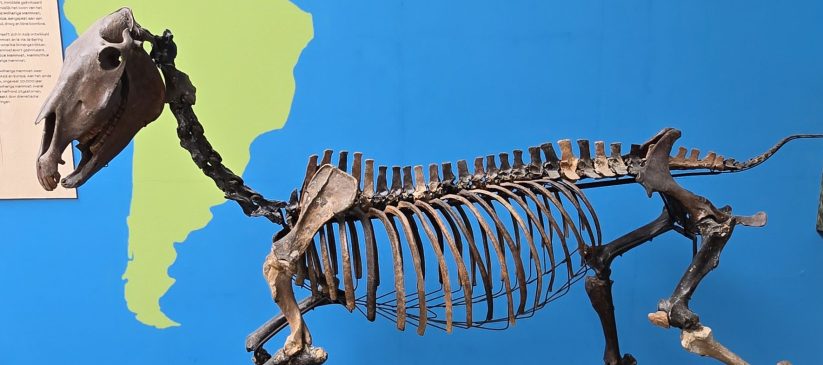
Composite skeleton of the wild horse. Constructed from numerous different bones from various animals, recovered from the North Sea seabed. During the Pleistocene, especially around 40,000–50,000 years ago, wild horses were abundant on the vast plains of the dry North Sea between the British Isles and the Netherlands. They were likely the most common large […]