Wild Horse
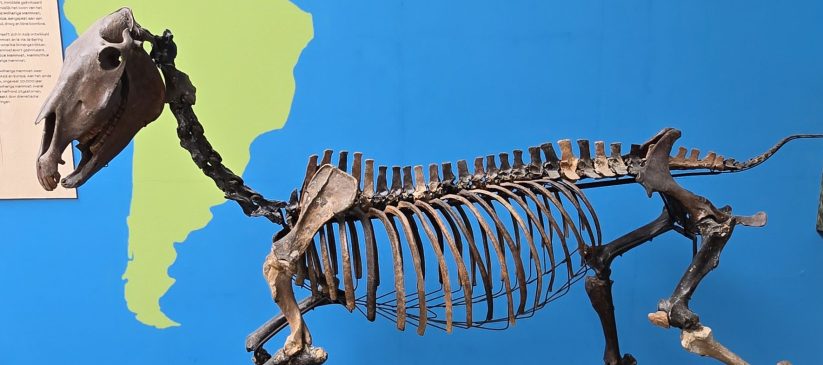
Composite skeleton of the wild horse. Constructed from numerous different bones from various animals, recovered from the North Sea seabed. During the Pleistocene, especially around 40,000–50,000 years ago, wild horses were abundant on the vast plains of the dry North Sea between the British Isles and the Netherlands. They were likely the most common large mammals, as evidenced by the enormous quantities of teeth and bones from these large grazers, standing approximately 180 cm at the shoulder, now recovered from the North Sea. Complete skeletons of wild horses have not been found on the seabed of the North Sea, but tens of thousands of bones have been recovered, allowing for a composite skeleton to be assembled. This dry North Sea area is referred to as Doggerland, a kind of sunken Atlantis. Wild horses became extinct in this region before 25,000 years ago, reappearing only in the Holocene, the present era, as domesticated animals.